



The Benefits of Speech Therapy
Rebound Physical Therapy provides therapy specifically tailored to the speech, voice, language, and swallowing needs of both our adult and pediatric patients. Our speech therapists work hard to help patients develop strong speaking skills as well as refine the volume and quality of voice. They can help decrease issues patients have with eating, drinking, swallowing, and communicating. If you or your child are struggling with an issue that is impairing your speaking capabilities, contact our clinic today to learn more about how speech therapy may benefit your condition.
Speech therapy can help children and adults
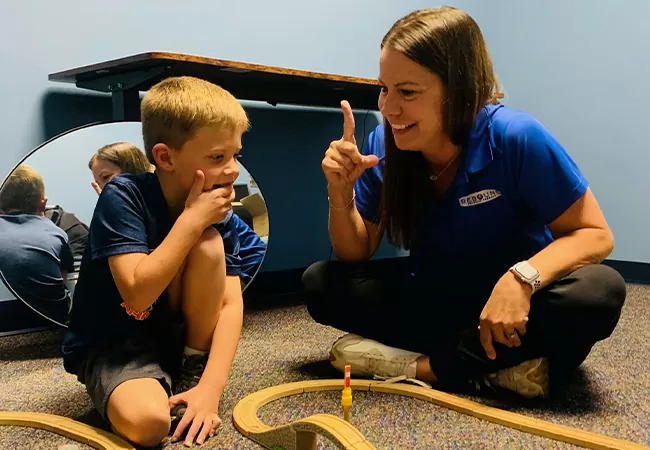
Rebound Physical Therapy works with patients of all ages and ensures the best quality of care for everyone. Our clinic offers speech therapy for both children and adults. Many factors can cause a child to have difficulty with speech, swallowing, aversions to food, or cognitive issues. Our pediatric patients face developmental delays and have challenges meeting their milestones with speech and language, making it difficult for them to interact with others, learn, explore, and play.
Adult speech difficulties are common and come in many forms, including stuttering, dysarthria (a problem with motor control of speech), voice problems, and articulation difficulties. These issues can cause a person not to want to communicate or become emotionally withdrawn from others. Some of our adult patients may struggle with speech and voice disorders as a result of nerve damage or traumatic injuries as well.
GUESS WHAT? Speech Therapy is now available our Hillsdale clinic.

Areas speech therapy can strengthen
Speech therapy encourages individuals to develop effective speaking and listening skills, improve loudness of voice, and re-train cognitive skills. It also aids in improving confidence and morale.
Treatment at our clinic focuses on the following issues in children and adults:
- Any chewing/swallowing difficulties or changes
- Food aversions
- Difficulty talking
- Difficulty expressing thoughts or identifying common objects or people
- Difficulty understanding written and spoken language
- Muscle weakness or tightness of the tongue or throat
- Changes in memory, attention, orientation
- Changes in the quality of the voice
Rebound physical therapists utilize neurological and speech exercises to help with a wide array of speech/language difficulties and can properly assess a person’s speaking abilities to determine if there are major problems. From there, their goal is to create a treatment plan with specific exercises to improve the condition over time.
Our Patients Get Results!
“Speech therapy has been wonderful for both of our boys in different ways. Our older son has always been a child who has understood language and had a large vocabulary but would not verbalize it. Through speech therapy he has been given a voice with the help of his AAC device. His device has allowed him to communicate his needs and gives him the ability to communicate words that he is not capable of saying at this moment. It allows him to have a voice and make decisions that he might not be able to verbally express. Our younger son was nonverbal until the age of three. He began using an AAC device through speech therapy and started to build his vocabulary. At the age of 4 he began to verbalize several of the words he was using on his device. By the time he turned 5 he could talk in short sentences and his speech goals shifted away from his device. He is now in kindergarten and full of questions. He went from no words to our chatter box in two years. He enjoys telling everyone what he knows and singing the occasional song. Speech has been a blessing for both of our children. While it can be hard work for them it is something that they always look forward to.”
— Matt and Jenna

Join Our Team
Founded in 1994 by Paul Silovsky, PT, Rebound is the leading PT clinic in the greater Topeka area with nearly 50 staff and thousands of happier, healthier patients. At Rebound, we don’t see people as “broken” with some unchangeable condition they have to cope with. We take a rebellious approach—we find out what’s stopping patients from doing what they want and figure out how to return them to the lifestyles they love. Here’s what matters to us:
- Doing what’s best for patients
- Maintaining work-life balance
- Clinical Autonomy
- Mentoring, training and paid CE
What To Expect At Your First Appointment
Our speech therapists at Rebound Physical Therapy are educated and prepared to evaluate and treat children and adults with speech, language, cognitive, and swallowing problems. They address decreases in swallowing, cognitive, and/or communicative function following brain injury, stroke, and brain tumors or coinciding with progressive conditions such as Alzheimer’s and Parkinson’s disease. When you or your child arrives for the initial consultation, a speech therapist will conduct a simple examination to determine the best possible treatment plan. Treatment depends on a patient’s specific situation and speaking abilities. Your therapist will be able to determine your strengths and weaknesses and how they change or improve over time.
This will allow them to adjust your treatment plan accordingly to include a multitude of different methods, including the following:
- Advanced oral-motor treatments
- Neuromuscular reeducation
- Functional computer retraining
- Intensive voice programs
- Traditional speech therapy techniques
One of our speech therapists will work with you in a relaxed, friendly setting on a series of exercises. The speech therapy exercises can range from tasks that strengthen the muscles of the face, tongue, and throat to vocabulary development and even basic communication skills like making eye contact when speaking to others.
Contact Rebound Physical Therapy today for speech therapy
There is no reason to let a speech problem get in the way of your child’s development or your own well-being. Rest assured that you’re in good hands at our clinic. We do our best to create a warm and welcoming environment in which you or your child can improve your speaking skills.
It’s our #1 priority to see all of our patients through to the end of their treatment and have them feeling more confident in their speech and language abilities. If you or a loved one is struggling with a speech impediment, swallowing issue, or voice problem, contact our clinic today to make an appointment for an evaluation.
FREE WORKSHOP
Pediatric Speech Therapy – Identifying the
Signs and When to Seek Help.
Led by Jennifer Stous, MSCCC-SLP on Wednesday, November 20th, 2024 @ 6:30 p.m.

3 Ways to Practice Gratitude
Did you know that being grateful is actually good for your health? It’s true!
We all love Thanksgiving for the excellent food, football, and time spent with family, but truthfully, this holiday means much more. Practicing gratitude can lead to greater happiness all year long. According to Harvard Health Publishing, “Gratitude helps people feel more positive emotions, relish good experiences, improve their health, deal with adversity, and build strong relationships.”
If you want to implement more gratitude in your own life, take a look at these 3 tips.
1. Write thank you letters
Remember writing thank you letters? How long has it been since you wrote one? You don’t need to have a wedding, graduation, or other big life event to thank the people in your life. Try writing thank you letters to your friends and family for the little things– you’ll be surprised at how good it feels!
2. Write down what you are grateful for every day
This might sound intimidating, but it doesn’t have to be! Take a few minutes each morning or evening to write down at least 3 things that you are grateful for in your life. This repeated action helps us shift into a more positive mindset and can help fight symptoms of depression and anxiety.
3. Use visual reminders
It can be hard to remember to practice gratitude. With your hectic schedule, sometimes it can feel impossible to sit down, take a moment to breathe, and reflect on your blessings. Visual cues can be a great tool for reminding us to take a beat.
Something as simple as sticky notes, a poster, or even your home screen on your phone or laptop can help us remember to slow down and shift to a positive mindset.
Sources:
- https://www.health.harvard.edu/healthbeat/giving-thanks-can-make-you-happier
- https://www.asha.org/public/speech/disorders/dysarthria/
- Food Aversion in Toddlers: Is It A Sensory Issue? | NAPA Centernapacenter.org › food-aversion
- Neuro Muscular Reeducation Treatment | Direct Orthopedic …www.directorthocare.com › treatment › neuro-muscular…