

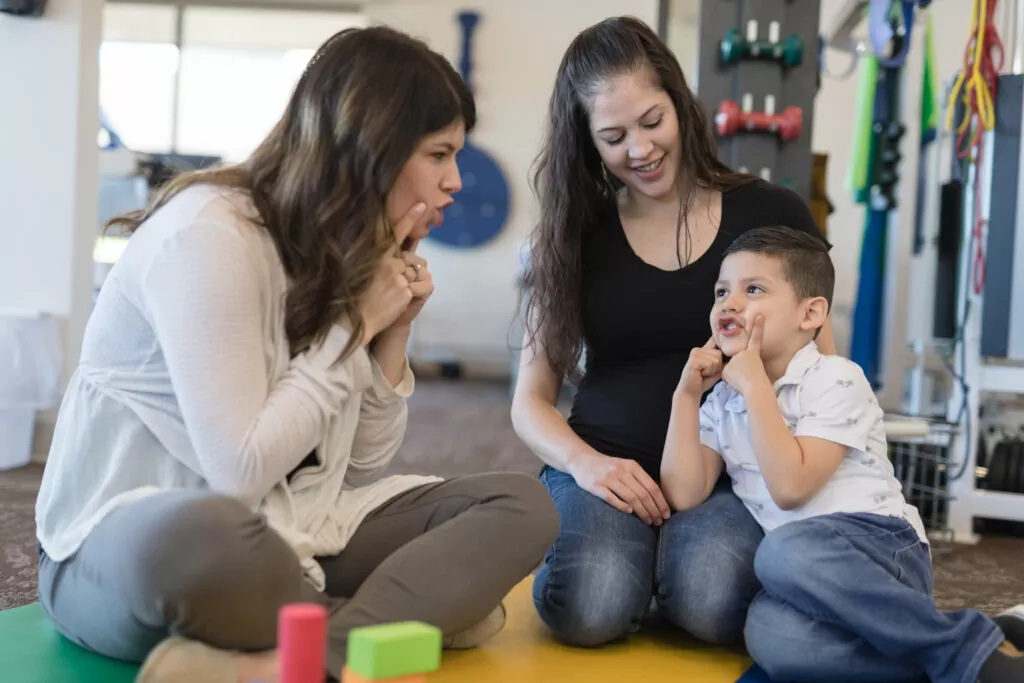
Does your child seem to struggle with communication, like their words don’t come out the way they want? For some children, this challenge could be caused by speech apraxia, a motor speech disorder that affects their ability to plan and coordinate the movements needed for speaking.
In this blog post, we’ll explain what exactly speech apraxia is, signs that your child has this condition, and how pediatric speech therapy at Rebound can support your child’s communication skills.
What Is Speech Apraxia?
Speech apraxia, also called childhood apraxia of speech (CAS), is a condition that impacts how the brain sends signals to the muscles used for speech. With this condition, a child’s speech challenges aren’t due to muscle weakness or a lack of intelligence.
Children with apraxia know the words they want to say and how they want to say them. But they struggle with motor planning, or the ability to coordinate the right movements needed for speech.
Signs of Childhood Apraxia of Speech
Some of the most common signs of speech apraxia in children include:
- Inconsistent speech errors, where they can pronounce a word correctly one time and say it incorrectly the next time they say it.
- Difficulty imitating speech sounds, even if they understand the words.
- Visible effort to make the mouth movements needed to make a specific speech sound.
- Simplifying speech by using fewer sounds or avoiding complex words altogether.
How Pediatric Speech Therapy Can Help
Speech therapy for apraxia focuses on helping children build the motor planning skills they need to communicate effectively. Our speech therapists use proven and fun activities to address the unique challenges of each child. Some common techniques we use include:
- Sound repetition drills: We’ll guide children in repeating specific sounds, syllables, and words to strengthen the connection between their brain and the muscles used for speech. For example, a child might practice saying “ba,” “da,” and “pa” multiple times during a session.
- Breaking words into parts: To make speech less overwhelming, we often help children break longer or complex words into smaller chunks. A child might work on saying “cat-er-pil-lar” syllable by syllable before practicing the word as a whole.
- Using visual and tactile prompts: We may incorporate mirrors to help children see how their mouth moves or use gentle touch cues to guide the lips, tongue, or jaw into the correct positions for speech.
- Rhythmic and melodic activities: We might use rhythmic speech exercises, such as clapping or tapping to syllables, to help reinforce motor patterns. Singing simple songs can also make speech practice more engaging.
- Interactive games: We’ll often use games like “Simon Says” or picture-matching activities to encourage speech practice in a playful, low-pressure environment.
Reach Out to Rebound for Expert Support
If your child is struggling to communicate or they seem to find speech especially challenging, our experts at Rebound can help. Early intervention makes a significant difference in overcoming speech challenges like apraxia.
Give us a call at (785) 367-3079 today to schedule a consultation with one of our speech therapists. We can provide personalized care to help your child find their voice and communicate with confidence.